The First Cigarette
Chloe, 20, was the friend Mr. Daniel Reyes trusted with his daughter. Then he learned she had given Sofía her first cigarette. When Chloe comes to the house and Sofía isn’t home, a very angry man is waiting — and he gives her a choice.
The afternoon sun was on the porch of the Reyes house when I reached the door, my backpack heavy on one shoulder. I had come expecting Sofía. The man who opened it was her father, and I knew, before he said a word, that she was not home.
I’m Chloe. I’m twenty years old, a second-year literature student at the same university as Sofía Reyes, and I have spent more nights under this roof than I have under my own this semester. I used to think that meant I belonged here. This afternoon I already knew I didn’t, not the way I had.
Sofía is twenty too, with long black hair she usually wears loose. We met in a first-year seminar, two desks from each other, and by October we were finishing each other’s sentences. Study sessions at her kitchen table that turned into sleepovers. Rides to campus in her father’s old gray Honda. Sunday dinners I was never formally invited to and never once turned down. I kept a toothbrush in the hall cupboard. I knew which floorboard in the upstairs hallway creaked.
Mr. Daniel Reyes is forty-eight. He has been a widower for six years, and he raised Sofía alone in this pale, sunlit house with the wooden floors and the windows that always seemed open. He is tall, a little weathered, dark hair going gray at the temples, and he wears the same kind of plaid shirts and khaki trousers whether he is fixing a hinge or sitting down to eat. He is not a man who raises his voice. He is a man who looks at you until you tell the truth.
He treated me like family. That is the part that still sits in my chest. When my car wouldn’t start in the university lot last March, he came with a toolbox and a thermos of coffee and stayed until the engine turned over, then followed me home to be sure. When I had a fever during midterms, he made soup and left it in a pot on the stove with a note in his small, precise handwriting: Eat. Rest. I will drive you on Thursday. I ate. I rested. He drove me. He used to say, almost offhand, “You’re good for her, Chloe. I don’t worry when she’s with you.”
I wanted to be the person he thought I was.
Which is why the cigarette was such a stupid, small, unforgivable thing.
It was a Thursday after a long seminar, the two of us on the back steps of the library, the late sun on the brick. I had a pack in the inner pocket of my jacket, a habit I kept quiet because I knew how Daniel felt about it. Sofía had been watching me for weeks. That afternoon she asked, not joking, if she could try one. I should have said no. I knew I should have said no. I lit it for her anyway, showed her how to hold it, and watched her cough and then laugh, eyes watering, and I laughed too, because it felt like nothing, like a secret between friends, like I was older and generous instead of careless.
I thought that was the end of it.
It wasn’t. Two nights later, while I was in my own apartment finishing a paper, Sofía was at their kitchen table in her gray hoodie, her long black hair falling forward over the open books. She told me all of this afterward. The house was quiet. She heard his steps first, and then her father was standing over her, and in his hand was a crumpled pack of cigarettes. My pack. The one I thought I had kept in the inner pocket of my jacket.
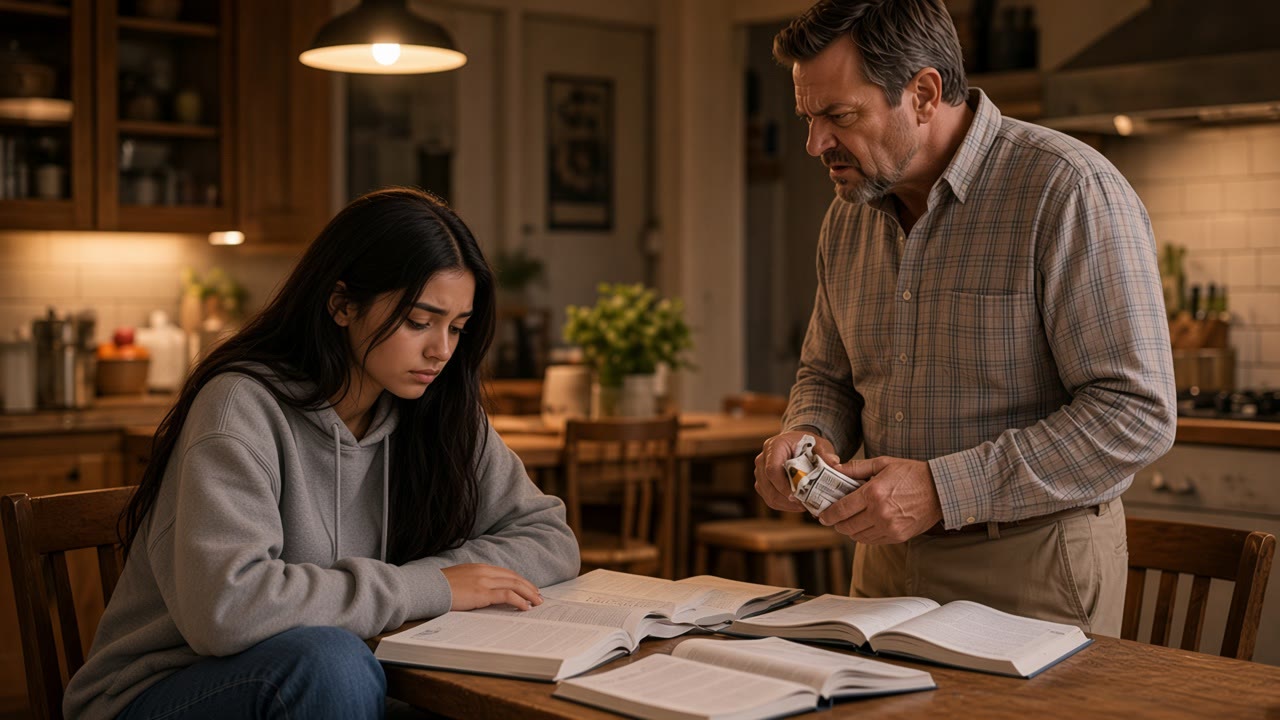
He didn’t raise his voice. Sofía said he didn’t have to. He turned the pack in his fingers as if it were evidence and asked her, once, where it had come from.
They argued. She said it was only one, that she was twenty, that it wasn’t a crime. He said this was his house, and that he had not raised her to be careless, and that he wanted the truth. And Sofía, who does not lie to him for long, told him it had not been her idea. She told him it was me. Chloe. The blonde. The friend he had trusted in this house. I was the one who had given her the first cigarette. I was the one who had lit it.
He did not punish her. She was very clear about that, later, her voice small on the phone. He looked at her for a long time, and then he set the pack down on the table, and the anger in his face changed direction. It was no longer about her. It was about me. He had trusted me; that was the only reason he had let his daughter spend so much time with me — the sleepovers, the study sessions, the rides. And I had put a cigarette in her hand.
“He isn’t going to do anything to me,” she said. “He’s furious with you.”
On Friday night she texted: He knows. I told him it was you. I’m sorry. I sat on the edge of my bed with the phone in both hands and felt the floor drop. On Saturday morning there was another message: I’m at my aunt’s until Sunday. I didn’t know if that was her idea or his. And still I went to the house that afternoon, because some stubborn, guilty part of me knew that disappearing would be worse.
I stood on the porch in a white tank top and denim jean shorts, the backpack strap tight in my fist, the late sun warm on the street behind me. He opened the door and held it, and he did not smile. He looked at me the way you look at someone you have already decided about.
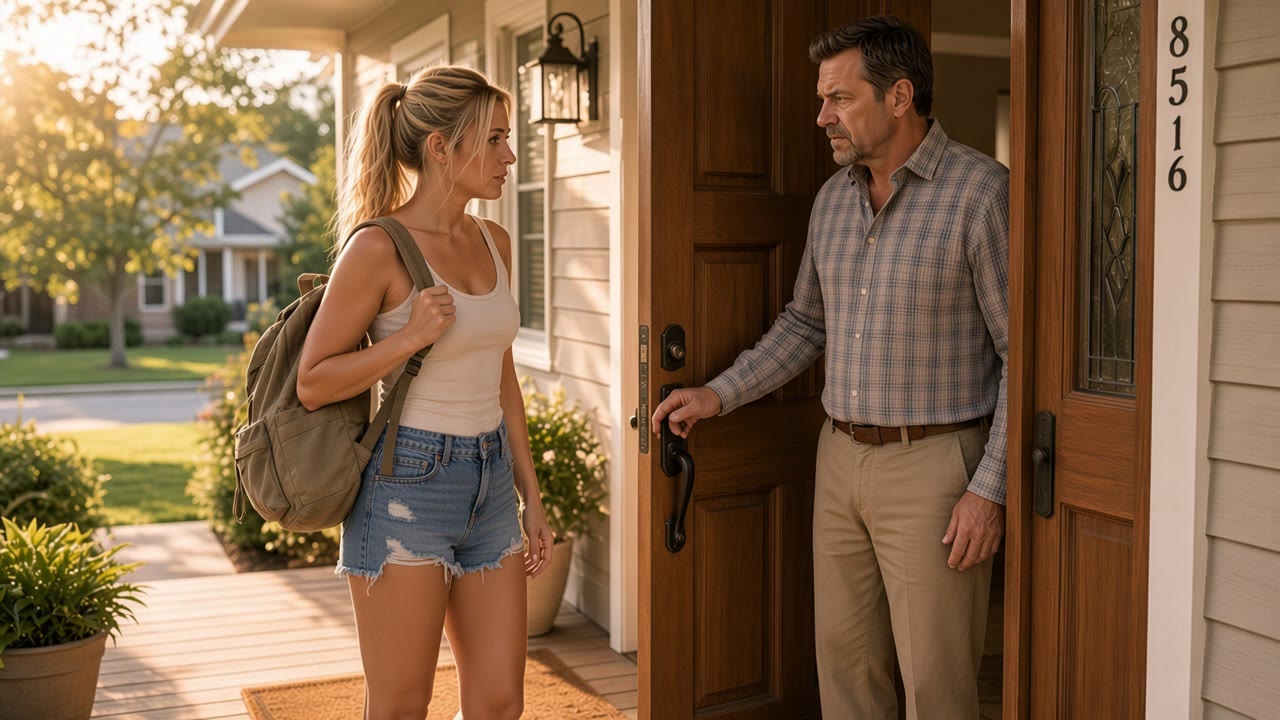
“She’s not here,” he said.
“I know.” My mouth was dry. “Mr. Reyes, I—”
“Inside.”
The house had the particular quiet of a place with only one person in it. He let me step past him and closed the door with a soft, final click. He had on the same worn blue-and-gray plaid shirt and khaki trousers. He pointed me toward the kitchen and did not offer me anything to drink.
“You knew how I felt,” he said, once we were standing there, the Saturday sun on the tile. “And you did it anyway.”
“I did.” I made myself look up. “I’m sorry. I was stupid. I thought it was nothing, and it wasn’t. That’s why I came back. I didn’t want to hide it.”
“I am angry, Chloe. More angry than I have been in a very long time. And I am disappointed, which is worse. I thought I knew you. I let my daughter spend nights here with you. I let you drive her. I left you my keys. I told her aunt, more than once, that I was not worried, because she had you. And you put a cigarette in her hand.”
“I know.” My voice came out smaller than I wanted. “She is twenty, and she is still your daughter, and I was careless with her.”
He studied me for a long moment, the way he studies a problem he already knows how to fix and does not want to. Then he nodded once, slow.
“Then we are going to settle this today,” he said. “Not with a conversation you can walk away from and forget. You have two choices, Chloe, and I mean both of them. You can pick up your bag, walk out that door, and not come back to this house. Sofía will understand, in time. Or you can stay, and you can take the consequence I would have given her if I had found her doing it alone, and you will not argue with me about it.”
The clock ticked. Somewhere in the neighborhood a dog barked and then stopped.
I thought about the toolbox in the trunk of the Honda, and the soup, and the note, and all the Thursday nights I had sat across from him and felt, for the first time in years, looked after. I thought about Sofía’s face when she asked me for the cigarette, and the way I had said yes as if it cost me nothing.
“I don’t want to leave,” I said. “I respect you. I knew the rule, even if we never wrote it down, and I broke it, and I feel sick about it. I’ll stay. I’ll accept it.”
“Say it clearly.”
“I choose to stay. I accept the consequence.”
“Good.” There was no softness in it. “Put the bag down.”
I slipped the backpack off my shoulder and set it by the door, next to the mat where I had already toed off my white sneakers. “Now listen to me.” His voice was short and cold. “You will take off the shorts. You will fold them, and you will leave them on the chair. Then you will come with me.”
My face burned. I was wearing the plain white tank top I always wore in warm weather, and the denim jean shorts I had put on because it was Saturday. My fingers found the button. The zipper sounded too loud in the quiet kitchen. I pushed the shorts down over my hips, stepped out of them, folded them once, and laid them on the chair. I stood there in the tank top and my plain white briefs, the tile cold under my bare feet, the afternoon sun very bright on my legs.
He looked at me without a flicker of anything I could use as comfort. Then he put his hand at my hip, firm and low, and turned me toward the hall.
“The study,” he said. “Walk.”
I walked. The hallway of the Reyes house has always been a kind place in my memory: late light, the click of the study door, Sofía calling from upstairs. It did not feel like that now. It felt long. The wooden floor was warm in the patches of sun and cool in the shade, and every few steps a floorboard creaked under my bare feet, a sound I had heard a hundred times on the way to borrow a book and had never heard like this. His hand stayed where it was, at the small of my back, just above the waist of the briefs, steering me, not rough and not gentle either. I could feel the heat of his palm through the cotton. He did not speak. The silence was worse than any lecture.
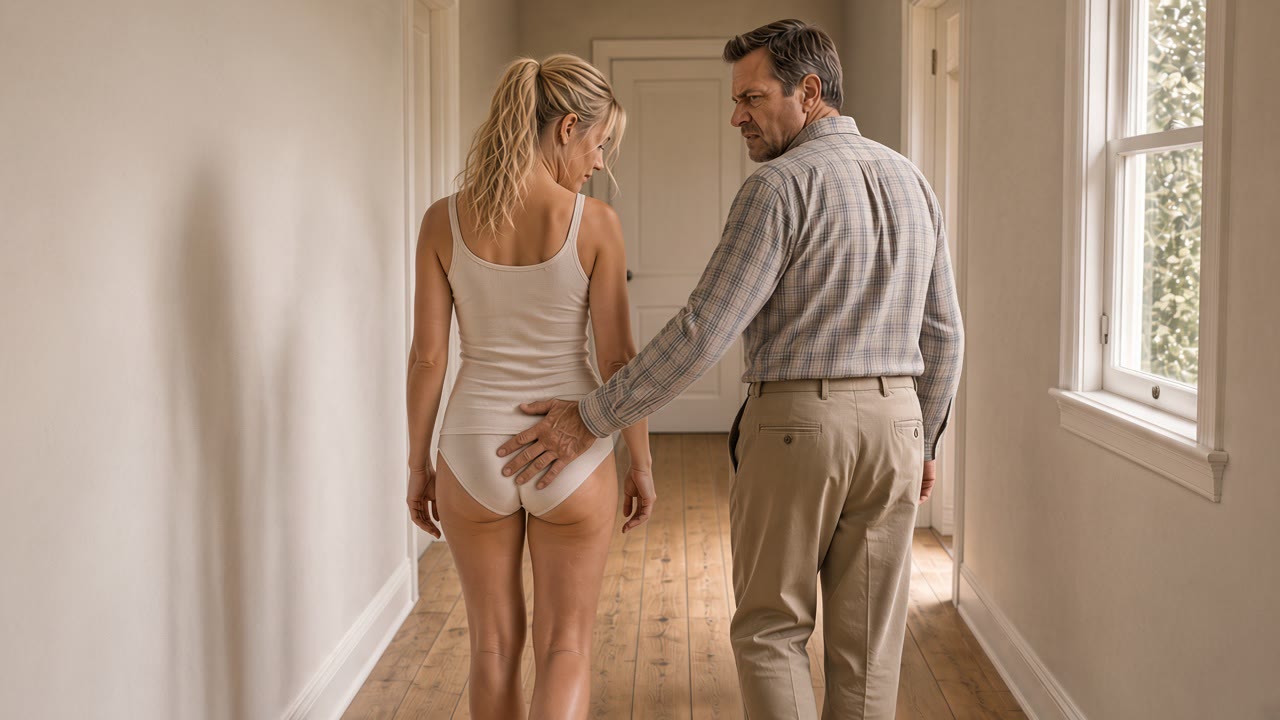
We passed the narrow table with the bowl of keys, and the row of photographs along the wall. Sofía at ten on the front steps, her long black hair in a braid. Sofía in her university hoodie, long black hair over his arm. Sofía at a birthday dinner I had helped him cook. I had loved those pictures. Now they felt like evidence of a trust I had spent. I kept walking.
“Eyes forward,” he said, only that.
The study door was closed, which it almost never was. He stopped me in front of it with the slightest pressure of his hand, and for a moment we only stood there, my heart going so hard I was sure he could feel it. I could smell the soap he uses, and the faint coffee on his breath, and the warm wood of the house itself.
“This is the room,” he said. “You know it.”
“Yes, Mr. Reyes.”
He opened the door. The study is paneled in dark wood, with tall shelves of books I have borrowed without asking and always brought back, a heavy desk under the window, a worn rug, and a straight wooden chair that usually sits against the wall. The afternoon light came in hard and slanted. He let go of me.
“Stand there. Hands behind your back.”
I did as I was told, in the middle of the rug, the tank top suddenly too thin, my ponytail brushing my shoulder when I lowered my head. I heard him behind me: the soft sound of his sleeves being rolled higher, the scrape of the wooden chair as he pulled it from the wall into the center of the room. Each sound made my pulse jump. He took his time. That, I understood, was the point.
When I dared a glance, he was sitting on the chair, back straight, not leaning, and he pointed at the floor in front of his knees.
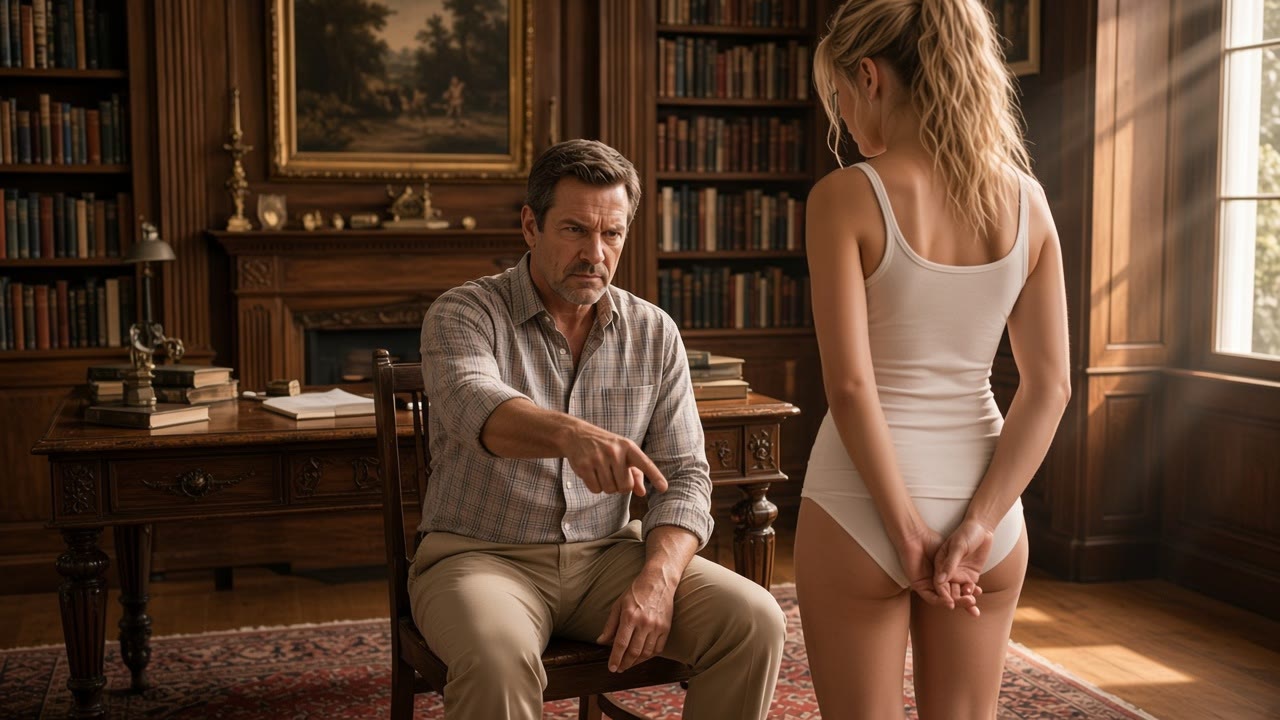
“Here.”
I came and stood where he pointed, close enough to see the line of his mouth, the anger still held tight in his jaw. The wait stretched. A clock in the hall ticked. My hands were still clasped behind me, fingers cold, and I could feel a drop of sweat at the small of my back where his palm had been.
“Tell me what you did,” he said. “Plainly.”
“I gave Sofía her first cigarette. I lit it for her. Behind the library, on a Thursday. I knew you wouldn’t have allowed it, and I did it anyway.”
“And what did I do, all this time, that made you think my trust was something you could spend?”
“Nothing.” The word caught. “You trusted me. You let her spend all that time with me because you thought I was careful with her. I wasn’t.”
“No. You were not.” He drew a breath through his nose, slow, as if he were putting the anger somewhere he could use it. “You will go over my knee, Chloe. You will stay there until I am finished. You will not count, and you will not ask me to stop because it stings. If you want this to end, you use the door. That is the only way out, and it is the same choice I already gave you. Do you still accept it?”
“Yes,” I said. “I still accept it.”
“Then come here.”
I lowered myself over his lap, clumsy with nerves, my palms finding the worn rug, my blonde ponytail slipping forward over my shoulder. The khaki of his trousers was rough against my stomach. His left arm settled across my waist, heavy and certain, and for a moment he only rested his right palm over the white cotton, still and unhurried, and the waiting was almost worse than anything that could come after. I could feel my heartbeat in my throat. The study smelled of paper and wood and the faint coffee on his breath.
“You will remember this house,” he said, low. “And you will remember what it costs to be trusted in it.”
“Yes, Mr. Reyes,” I whispered.
He lifted his hand.
To be continued… The full chapter, uncensored and with exclusive images, continues on Fanvue: Read what happens next on Fanvue →
The story continues
Didn't want it to end?
Read the full chapter on Fanvue, with exclusive uncensored images and videos, and get new chapters before anyone else.
Read the rest free for 7 days →Free trial, only 10 spots

More Stories
The Last Practice
Valentina, 19, was the star of the university club team — until she stopped training and her arrogance cost them the championship. After the final, she throws herself into Coach Hale’s arms, devastated. He holds her. Then he tells her he is going to take that brattiness out of her.
storyThe Hairbrush
Hannah, 23, came back to a quiet retreat house of her own free will and accepted its rules. Then she started falling for the stern nun who ran it, and one night Sister Agnes, who had begun to trust her, found her touching herself after lights-out. Now she stands in the Quiet Room before a very angry, very disappointed woman, and hands over the wooden hairbrush herself.